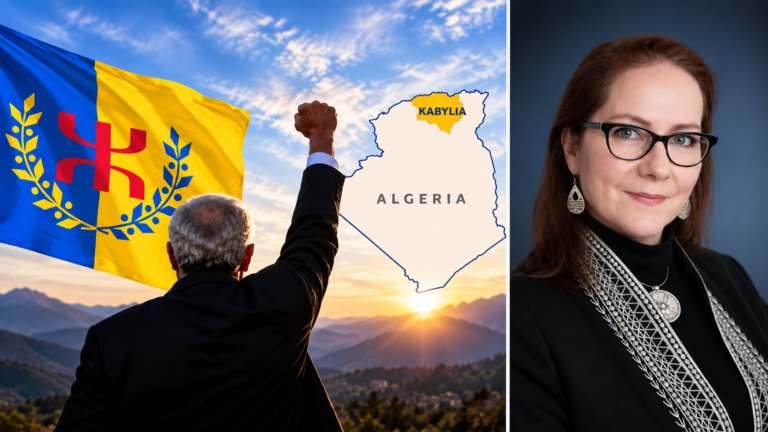


Criminalized at Home, Recognized Abroad: When Resilience Outlasts Lawfare. By Elisabeth R. Myers

PRESS REVIEW (SIWEL) — In an analysis examining more than two decades of confrontation between the Kabyle independence movement and the Algerian state, Elisabeth R. Myers, founder and CEO of Strategix Legal, an international advisory firm specializing notably in legal strategy, government affairs and strategic communications, explores how the MAK and the Kabyle Government in Exile (Anavad) have responded to criminalization and repression through institution-building, international law and sustained diplomacy. From the December 14, 2025 Declaration of Independence to UNPO’s recent resolutions, Myers describes a long-term strategy based on resilience and the incremental accumulation of international legitimacy and recognition.
How Algeria’s campaign to criminalize the Kabyle independence movement has failed to stop its strategy of institution-building, international law, and diplomacy
By Elisabeth R. Myers
For more than two decades, Algeria has tried to suppress the Kabyle independence movement through the instruments of the state: criminal prosecution, terrorism designations, surveillance, imprisonment, restrictions on association and expression, and pressure extending beyond Algeria’s borders.
The strategy has undoubtedly imposed a heavy human cost. What it has not done is stop the movement.
Instead, the Movement for the Self-Determination of Kabylia, known by its French acronym MAK, and the Kabyle Government in Exile have pursued an increasingly deliberate strategy outside Algeria: build institutions, establish a legal foundation, internationalize the question of Kabylia, cultivate relationships with legislators and policymakers, and pursue recognition incrementally rather than expecting it to arrive in a single diplomatic breakthrough. It has been, above all, an exercise in persistence and adaptation.
The XXI General Assembly of the Unrepresented Nations and Peoples Organization in the Hague last month expressly recognized the Kabyle as a distinct people possessing the right to self-determination and adopted a resolution formally recognizing the Declaration of Independence of Kabylia, proclaimed in Paris on December 14, 2025, and the establishment of the Federal Republic of Kabylia. A companion resolution condemned Algeria’s repression in Kabylia under Article 87 bis and affirmed a principle at the heart of the Kabyle campaign: “the right to self-determination is not a crime.” The General Assembly also elected Kabyle representative Mourad Amellal to another two-year term on UNPO’s Presidency Board, part of the organization’s leadership structure.
This is not merely another expression of concern about Kabyle human rights. This is an international organization representing unrecognized peoples and nations now moving from recognizing the Kabyle people’s right to self-determination to expressly recognizing their Declaration of Independence and the establishment of the state they have proclaimed.
International recognition rarely begins with the opening of an embassy. It begins with legitimacy, and legitimacy is precisely what the Kabyle movement has spent years trying to construct.
From Cultural Rights to Statehood
The modern movement grew out of the Black Spring of 2001, when long-standing demands for linguistic, cultural, civil, and political rights hardened into a broader movement for Kabyle self-determination. Initially, MAK sought autonomy within Algeria. Over time, repression and the Algerian government’s refusal to negotiate drove the movement toward a different conclusion.
What followed was a two-decade evolution, with each closed political avenue pushing the movement toward the next.
In 2010, the movement established a provisional government in exile—today known as the Kabyle Government in Exile—to create a political structure capable of representing Kabylia internationally. It subsequently developed representative institutions, including a Kabyle Parliament, a draft constitution, and a system of justice. In 2024, the movement formally dropped the word “provisional” from the government’s name.
Those steps mattered because they changed the character of the campaign. The movement was no longer merely demanding rights from Algeria; it was building the institutional architecture of an alternative political authority.
That strategy became explicit on April 20, 2024, when MAK proclaimed what it called the “rebirth” or renaissance of the Kabyle State outside United Nations headquarters in New York. In October 2025, an Extraordinary Global Congress unanimously mandated the Kabyle Government in Exile to declare independence.
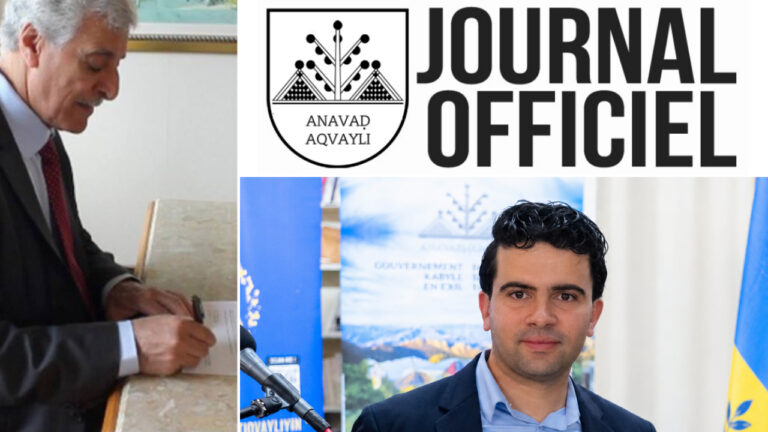
On December 14, 2025, Ferhat Mehenni formally proclaimed Kabylia’s independence in Paris. The Declaration presented Kabylia as a federal, democratic, and secular republic and grounded the proclamation in the right of peoples to self-determination.
That moment was not the culmination of the diplomatic strategy. It was the beginning of its next phase.
Building the Legal Case First
As political space inside Algeria narrowed, the movement increasingly turned outward—and to international law. One of its most consequential decisions was to develop a legal foundation for the claim to self-determination before seeking political recognition.
On September 4, 2024, four leading British international-law barristers from Brick Court Chambers and Twenty Essex issued an independent legal opinion reaching two concise conclusions: the Kabyle are a “people” under international law and, as a consequence, possess the human right to self-determination.
The importance of the opinion was practical: it supplied a legal framework around which political advocacy could be organized.
The movement could now approach governments, legislatures, human-rights bodies, and international organizations with a developed proposition under international law: the Kabyles constitute a people, and peoples possess a right to self-determination.
Algeria’s Answer: Lawfare
Algeria has pursued precisely the opposite strategy.
Rather than treating Kabyle demands as a political dispute, it has increasingly treated them as a security problem. In 2021, Algerian authorities designated MAK a terrorist organization, while amendments to Article 87 bis of the Penal Code broadened the scope of terrorism-related offenses to encompass vaguely defined conduct involving territorial integrity and the system of government.
UNPO’s 2025 report on legal warfare identifies Algeria’s treatment of MAK as a particularly stark example of how expansive terrorism laws can be used against peaceful self-determination movements. The report documents arrests of activists, journalists, and individuals accused merely of association with MAK, as well as surveillance and intimidation extending into diaspora communities.
The same report describes cases in which facial-recognition technology allegedly contributed to terrorism prosecutions because individuals appeared in photographs with Ferhat Mehenni or the Kabyle flag.
Its broader conclusion is especially relevant today. Lawfare may shrink civic space at home while driving peaceful movements to seek political and legal avenues abroad.
UNPO characterizes communities that continue to challenge repression through non-violent means despite sustained legal and political pressure as “resilient peoples.” Kabylia increasingly looks like a case study in precisely that phenomenon. Each attempt to narrow the movement’s political space has required it to adapt: organizing abroad, building institutions, developing an international legal case, cultivating new diplomatic relationships, and finding new forums in which the Kabyle question can be heard.
That conclusion has now been translated into institutional action. At its 2026 General Assembly, UNPO expressly condemned Algeria’s repression in Kabylia under Article 87 bis, finding that its application criminalizes fundamental freedoms and, in particular, the right to self-determination. The resolution distilled the issue into a simple proposition: “The right to self-determination is not a crime.”
Algeria has attempted to label Kabyle self-determination in the vocabulary of “terrorism.” UNPO’s General Assembly has now answered with the opposite proposition, reinforcing the very international legal and political distinction the Kabyle movement has spent years trying to establish.
Repression at Home, Diplomacy Abroad
The strategic asymmetry is striking.
Algeria controls the territory, but the Kabyle movement has increasingly focused on controlling the narrative. While activists inside Algeria face severe restrictions, MAK and the Kabyle Government in Exile have pursued parliamentary, diplomatic, legal, cultural, and civil-society outreach across Europe, North America, and the Middle East.
The issue has increasingly entered the international political arena through legislative engagement, parliamentary questions, human-rights advocacy, religious-freedom initiatives, and sustained outreach to policymakers. The strategy is cumulative rather than spectacular: put the Kabyle question before one parliament, government, human-rights body, religious-freedom institution, and political constituency after another.
That strategy has become increasingly visible since the Declaration of Independence. In September 2026, Mehenni embarked on a concentrated round of diplomatic outreach in France, including discussions at the Apostolic Nunciature in Paris concerning the situation of Kabyle Christians and meetings with French political figures Robert Ménard in Béziers and Louis Aliot in Perpignan. The discussions ranged from human rights and religious freedom to the catastrophic summer fires, the Kabyle diaspora, and the movement’s political aspirations. Each meeting widens the circle of institutional and political interlocutors willing to receive the Kabyle leadership directly.
The international strategy also extends beyond conventional state-to-movement diplomacy. Kabyle representatives have increasingly cultivated relationships with other stateless nations and self-determination movements, building networks around a shared claim to political voice and national self-determination. In August, Mehenni joined representatives from Catalonia, Corsica, Kanaky, Guadeloupe, Martinique, Guyane, Sardinia, Brittany and other movements at the Ghjurnate Internaziunale di Corti in Corsica. These relationships broaden the movement’s international network and embed the Kabyle question within a wider community of peoples pursuing varying forms of sovereignty, autonomy, or decolonization.
Cultural and intellectual diplomacy has complemented that political outreach: Kabyle writers, scholars and cultural figures have developed a recurring presence at the influential Festival du Livre en Bretagne in Carhaix, whose 2025 edition made Kabylia its featured theme and brought Kabyle literature, language, scholarship, and political experience before a broad French and Breton audience.
The Christian dimension has also widened the international audience. A 2026 report submitted by the Christian Kabyle Coalition to the U.S. Commission on International Religious Freedom documented systematic church closures, prosecutions, religious restrictions, and the use of national-security laws against Kabyle Christians, linking religious repression to the broader denial of Kabyle civil and political rights. Recent events elsewhere in Algeria have reinforced the broader religious-freedom concerns underlying that advocacy. On September 4, police raided a Christian worship service at a humanitarian shelter for vulnerable women and their families near Oran and arrested all 12 Christians present on suspicion of holding an unauthorized non-Muslim religious service. The arrests came amid reports of a broader government effort to reorganize Algeria’s evangelical Christian community under a newly constituted national church structure. Together with the closure of Protestant churches in Kabylia, such developments give the Kabyle movement’s religious-freedom advocacy resonance beyond the question of Kabylia itself.
This is how an independence movement becomes difficult to isolate. Close one avenue, and another constituency may provide another. Human rights, religious freedom, indigenous rights, language rights, counterterrorism abuse, political prisoners, and self-determination each create another diplomatic constituency. Eventually, what a government insists is simply an internal matter becomes an international file.
Why UNPO matters
The UNPO is not the United Nations, but the organization’s history makes its recognition politically meaningful. The organization was created precisely to provide an international platform for nations and peoples excluded from the state-based international system. Former UNPO members include peoples that later achieved sovereignty or substantial international recognition.
Kabylia joined the UNPO in 2017. Nearly a decade of sustained engagement has now progressed from representation, to recognition of the Kabyle people and their right to self-determination, to recognition of the Declaration of Independence and the state they have proclaimed, and to a call for an independent international inquiry into the catastrophic August wildfires in Kabylia and for international organizations to monitor the humanitarian situation.
Historical Parallels
There is no exact precedent for Kabylia. Every successful independence movement emerges from a different legal, colonial, political, and geopolitical history. But several cases illustrate elements of the strategy Kabylia is pursuing.
Namibia. Perhaps the strongest institutional parallel is Namibia. Namibian representatives petitioned the international system against South African rule for decades, while the issue remained on the United Nations agenda and international diplomatic pressure accumulated. The General Assembly eventually recognized SWAPO as the authentic representative of the Namibian people, and a UN-supervised transition produced independence in 1990.
While SWAPO conducted an armed struggle, MAK is committed to peaceful political and diplomatic methods. The relevant lesson for Kabylia is the time horizon: decades of advocacy can precede a decisive political shift.
East Timor. East Timor offers another important analogy. While Indonesia annexed the territory in 1976, the United Nations never recognized it. For more than two decades, the Timorese cause survived through resistance, diaspora diplomacy, international advocacy, and sustained attention within the UN system. In 1999, international negotiations produced a UN-administered referendum, and East Timor became independent in 2002.
The lesson here is that a state may exercise territorial control for decades without extinguishing the underlying political question of self-determination.
Kosovo. Before declaring independence in 2008, Kosovo developed governing structures and democratic institutions under international supervision. Its declaration committed the new state to democracy, minority rights, and international obligations, and numerous states then recognized Kosovo. Kosovo followed armed conflict, NATO intervention, and nearly a decade of UN administration.
One strategic principle provides the clearest parallel: movements seeking statehood strengthen their case when they demonstrate the capacity to govern. That requires establishing institutions capable of leadership succession, internal organization, and continuity.
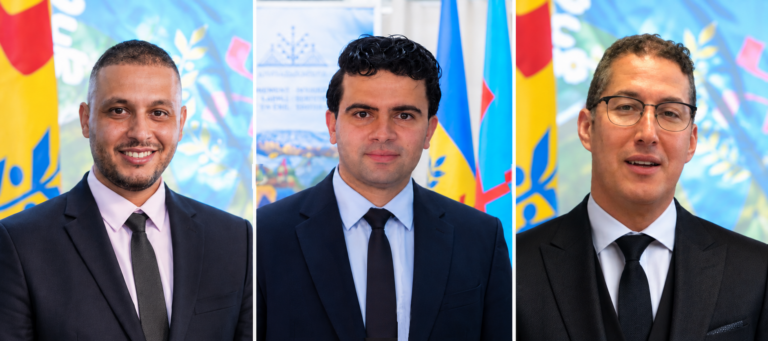
And Kabylia is doing just that. On September 13, 2026, MAK appointed Mulud At Azdin to succeed Reza At Sɛid as president of its Bureau Exécutif Général after At Sɛid’s six years in the post. At Azdin was charged with preparing the movement’s next congress, strengthening its organizational structures and expanding political training. The transition is less dramatic than a declaration of independence, but institution-building is often measured precisely by such ordinary acts of political continuity.
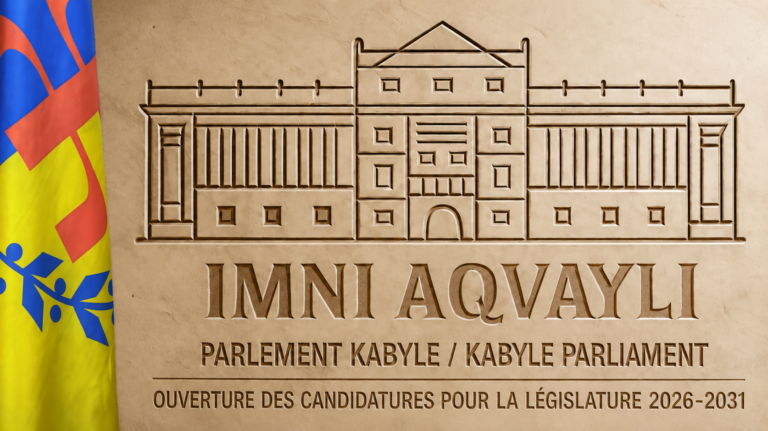
The same week, the Kabyle Parliament opened the selection process for its 2026–2031 legislature.
A Different Kind of Independence Campaign
Over more than two decades, the Kabyle campaign has repeatedly evolved while remaining committed to peaceful political action. It has built institutions in ways reminiscent of Kosovo, pursued the patient internationalization seen in Namibia, sustained a diaspora-driven diplomatic campaign that recalls East Timor, and grounded its claim in an explicit legal theory of self-determination.
None of this guarantees independence. Recognition is ultimately political, and governments recognize new states when law, principle, strategic interest, and geopolitical circumstances align sufficiently to make recognition possible. Algeria also remains a major regional state with substantial military, energy, and diplomatic relationships, and most governments will remain cautious about challenging its territorial integrity.
But that is precisely why the Kabyle movement’s strategy deserves attention. It does not depend on one dramatic diplomatic breakthrough. It depends on accumulation: one legal opinion, one parliamentary question, one human-rights report, one diplomatic meeting, one institutional relationship, one functioning political body, and one act of recognition at a time.
The movement’s principal strategic achievement may therefore be less visible than a declaration or a flag. It has adapted, institutionalized, internationalized, and survived while Algeria has attempted to criminalize it.
States can imprison activists, outlaw organizations, close political space, and label peaceful opponents “terrorists.” Such tactics can make organizing inside the territory extraordinarily difficult, but they can also push a political question beyond the state’s borders. Algeria’s reliance on lawfare has given the Kabyle movement another argument to carry abroad: meaningful internal self-determination has been foreclosed because peaceful political advocacy itself has been criminalized.
The historical record offers no guarantee that Kabylia will become an independent state. It does, however, show a remarkable trajectory of persistence: from cultural protest, to autonomy, to self-determination, to institution-building, to an international legal case, to a declaration of independence, and now toward incremental international recognition.
If the Kabyle movement ultimately succeeds while remaining committed to peaceful, non-violent struggle, that achievement would carry significance far beyond Kabylia. It would make the Kabyle case unusually important in the modern history of self-determination movements: an example of a people seeking statehood through law, institution-building, sustained diplomacy, and the patient accumulation of international legitimacy.
That is a trajectory Algeria may find considerably harder to reverse than to repress.
~~~~~~~~~~~~~~~~
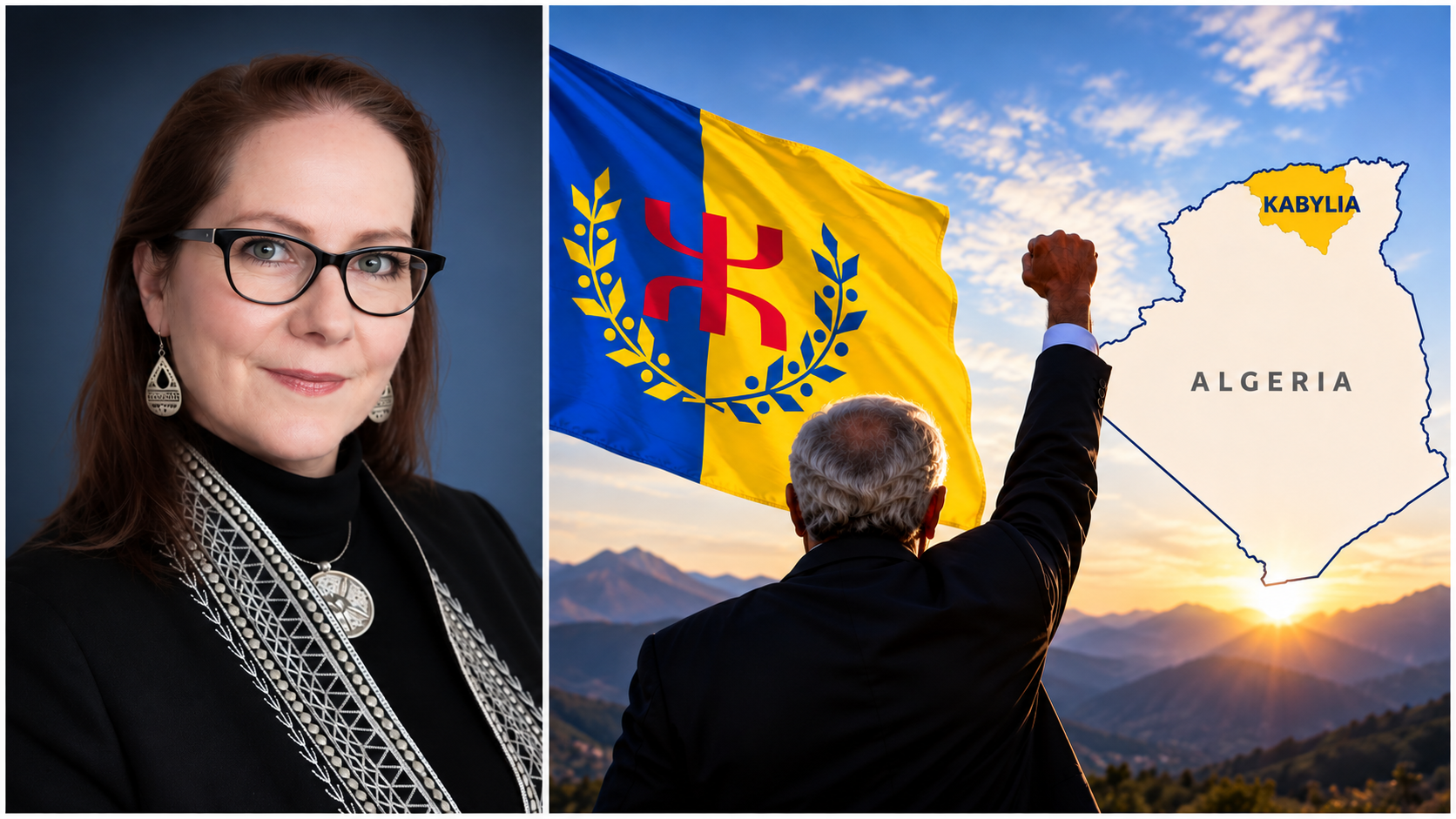
Elisabeth R. Myers is the founder and CEO of Strategix Legal, an international advisory firm focused on legal strategy, government affairs, investment facilitation, and strategic communications across Africa, Europe, and North America.
On X: @ElisabethRMyers
info@strategix-legal.com
SIWEL 200130 SEP 26
Traduction de l’article en français :