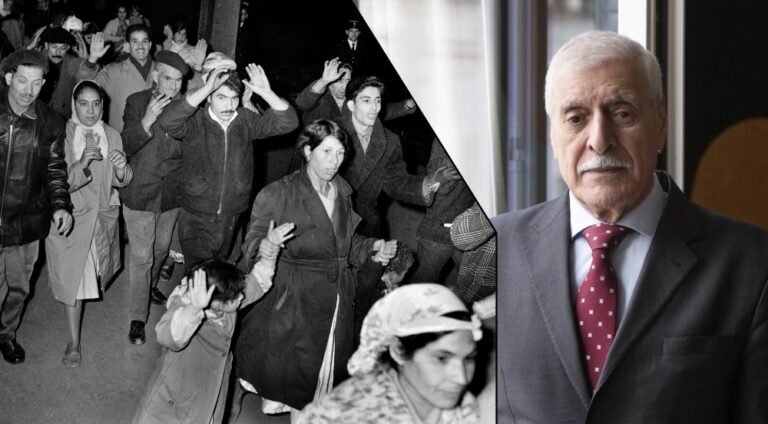

Israël face à la Déclaration d’indépendance de la Kabylie : un test stratégique et normatif, par le Dr. Emmanuel Navon
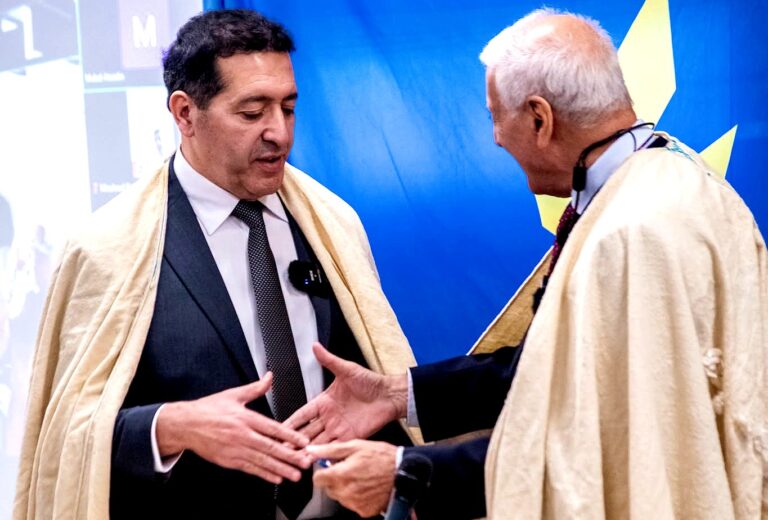
TEL AVIV (SIWEL) — À la veille de la proclamation officielle de l’indépendance de la Kabylie, le Dr. Emmanuel Navon, spécialiste reconnu des Relations internationales et Senior Fellow au prestigieux Jerusalem Institute for Strategy and Security (JISS), analyse les enjeux stratégiques, juridiques et politiques qu’une reconnaissance israélienne de la Kabylie ferait émerger. À travers le cas kabyle, c’est le double standard international en matière d’autodétermination qui est mis en lumière, ci-dessous son analyse complète :
[Version française]
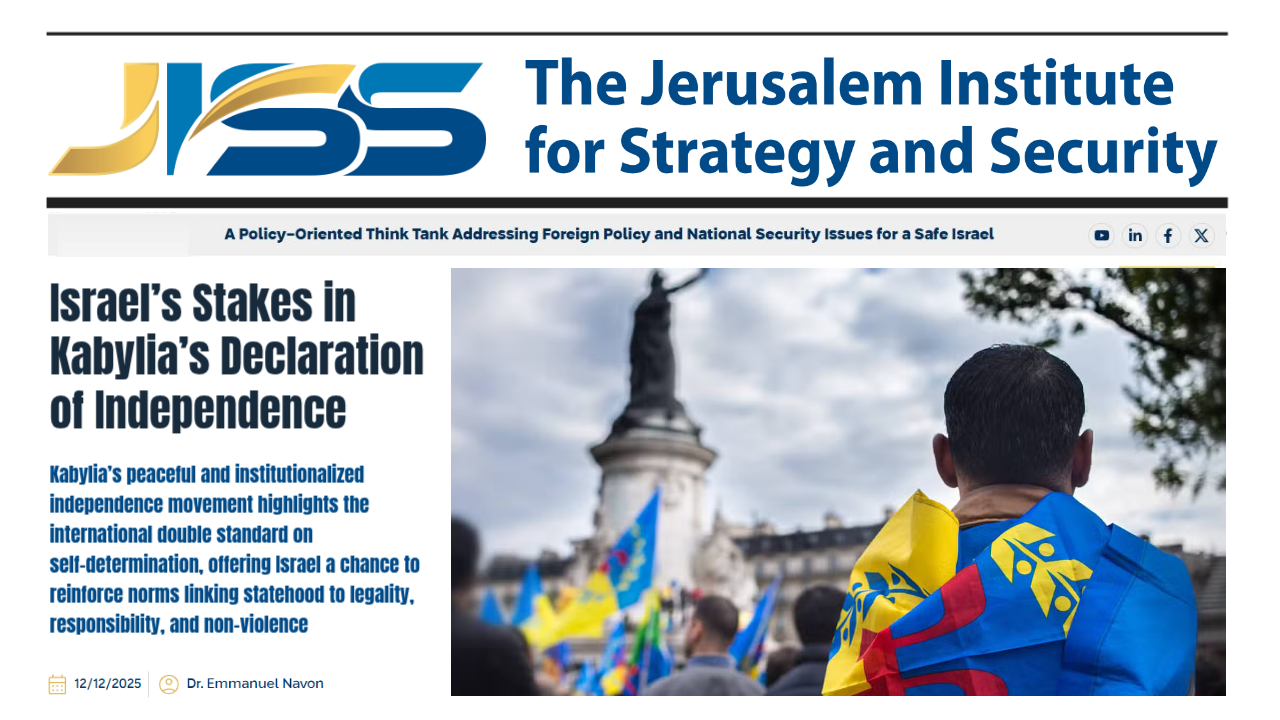
Les enjeux d’Israël dans la Déclaration d’indépendance de la Kabylie
Le mouvement indépendantiste kabyle, pacifique et institutionnalisé, met en lumière le double standard international en matière d’autodétermination et offre à Israël l’opportunité de renforcer des normes liant l’accession à l’État à la légalité, à la responsabilité et à la non-violence.
12/12/2025 / Dr Emmanuel Navon
Le 14 décembre 2025, des représentants du peuple kabyle proclameront l’indépendance de la Kabylie lors d’une cérémonie publique à Paris. Cette déclaration marque l’aboutissement de plus de deux décennies de mobilisation politique, de consolidation institutionnelle et de plaidoyer juridique menés par le mouvement national kabyle, principalement à travers le Mouvement pour l’autodétermination de la Kabylie (MAK) et son gouvernement en exil (Anavad).
Cette note d’analyse soutient qu’Israël devrait dépasser une posture d’observation prudente et adopter un soutien politique de principe à la revendication d’indépendance de la Kabylie, évoluant à terme vers une reconnaissance diplomatique. Une telle orientation s’inscrit dans la continuité de la stratégie historique de la périphérie d’Israël, renforce sa position normative sur l’autodétermination et la violence politique, et implique des coûts diplomatiques limités. Plus largement, elle positionne Israël comme un État prêt à soutenir des mouvements de libération nationale légaux et non violents au Moyen-Orient et en Afrique du Nord.
La question kabyle est complexe. Elle implique les dynamiques amazighes internes au Maroc, la réticence occidentale à créer des précédents en matière de sécession, ainsi que le contexte palestinien omniprésent dans lequel la politique étrangère israélienne est interprétée. Ces contraintes ne l’emportent toutefois pas sur la logique stratégique et normative d’un engagement israélien et d’une reconnaissance éventuelle. Elles soulignent au contraire la nécessité d’une clarté analytique et d’un leadership politique dans un environnement international marqué par une application incohérente des normes et une tolérance croissante envers la répression autoritaire.
La Kabylie : une nation authentique et un horizon politique verrouillé
La Kabylie est une région montagneuse du nord de l’Algérie, majoritairement peuplée d’Amazighs (Berbères), dont la population est estimée entre trois et quatre millions de personnes. Les Kabyles constituent un peuple au sens sociologique, culturel et historique du terme. Ils disposent d’une langue distincte, d’une identité collective continue, d’expériences historiques partagées et d’institutions communautaires durables, notamment la tajmaât, assemblée villageoise traditionnelle fondée sur la délibération et la responsabilité collective.
Après l’indépendance de l’Algérie en 1962, la Kabylie a été progressivement marginalisée au sein d’un modèle étatique centralisé fondé sur le nationalisme arabe et l’uniformité administrative. Au fil du temps, l’exclusion linguistique, la centralisation politique et la suspicion à l’égard de l’identité régionale ont transformé la Kabylie, pourtant actrice majeure de la lutte anticoloniale, en une région perçue par les autorités comme politiquement menaçante.
La répression violente des manifestations lors du « Printemps noir » de 2001 a constitué un tournant décisif, érodant profondément la confiance entre la Kabylie et l’État central. Les tentatives ultérieures visant à obtenir l’autonomie, la décentralisation ou une reconnaissance constitutionnelle de l’identité kabyle ont été systématiquement rejetées. La désignation du MAK comme organisation terroriste en 2021, malgré son engagement déclaré en faveur de la non-violence, a de fait éliminé les dernières voies d’expression politique interne.
Du point de vue des normes internationales, la Kabylie présente ainsi un cas clair de déni de l’autodétermination interne, dans lequel les voies pacifiques et institutionnelles de participation politique ont été méthodiquement fermées.
Maturité institutionnelle et représentativité
Comme tout mouvement national, la Kabylie connaît une diversité d’opinions quant à la stratégie et au statut politique final. Si le soutien aux droits culturels et la résistance au centralisme algérien sont largement partagés, l’adhésion à l’indépendance totale a évolué avec le temps et s’est renforcée sous l’effet d’une répression persistante.
De manière significative, le mouvement kabyle a adopté une stratégie institutionnelle plutôt qu’insurrectionnelle. Depuis 2010, l’Anavad fonctionne comme un gouvernement en exil. Un organe parlementaire représentatif (Imni) a été mis en place en 2020, et un cadre constitutionnel définissant un système politique laïque et démocratique a été élaboré. Cette institutionnalisation distingue la Kabylie de nombreuses revendications d’autodétermination et fournit une base à une légitimité politique progressive.
Pour Israël, la question pertinente n’est pas de savoir si le MAK représente actuellement l’ensemble des Kabyles — un critère rarement appliqué à des mouvements comparables — mais s’il démontre une continuité organisationnelle, une cohérence interne et une adhésion aux principes démocratiques et non violents. À ces égards, la Kabylie se compare favorablement à des mouvements ayant bénéficié d’un engagement international plus large.
Le fondement juridique : une autodétermination conforme aux précédents
La revendication d’indépendance de la Kabylie repose sur des principes largement reconnus du droit international, notamment l’article 1(2) de la Charte des Nations unies, les résolutions 1514 et 2625 de l’Assemblée générale, ainsi que l’avis consultatif de la Cour internationale de justice de 2010 concernant le Kosovo. Cet avis a clarifié que les déclarations unilatérales d’indépendance ne sont pas, en elles-mêmes, interdites par le droit international.
La doctrine de l’autodétermination réparatrice, invoquée par les représentants kabyles, soutient que lorsqu’un peuple est systématiquement privé d’autodétermination interne et soumis à une répression durable, le recours à l’autodétermination externe peut devenir juridiquement et politiquement justifié. Ce raisonnement a sous-tendu les réponses internationales dans des cas tels que le Timor oriental ou le Soudan du Sud, même s’il a été appliqué avec prudence et de manière inégale.
Israël a constamment affirmé que les questions de souveraineté doivent être traitées à travers la légalité, la procédure et la responsabilité. L’approche non violente et fondée sur le droit adoptée par la Kabylie est en adéquation avec ces principes et renforce ainsi les arguments qu’Israël a avancés dans d’autres contextes internationaux.
Raisons stratégiques en faveur d’une reconnaissance israélienne
4.1 Actualiser la stratégie de la périphérie d’Israël
La stratégie historique de la périphérie d’Israël visait à établir des partenariats avec des États non arabes et des minorités marginalisées par les ordres régionaux dominants. Les Accords d’Abraham ont considérablement renforcé l’intégration régionale d’Israël, sans pour autant éliminer la pertinence stratégique d’acteurs périphériques laïques, pro-occidentaux et opposés à l’islam politique.
La Kabylie constitue un tel acteur en Afrique du Nord. Sa direction promeut une vision laïque et démocratique, rejette la violence politique et a exprimé sa solidarité avec Israël, notamment après les événements du 7 octobre 2023. Des représentants kabyles ont également manifesté un intérêt pour une participation future au cadre des Accords d’Abraham, indiquant une orientation extérieure fondée sur la coopération régionale plutôt que sur la confrontation idéologique.
La reconnaissance de la Kabylie par Israël représenterait ainsi une adaptation contemporaine de la stratégie de la périphérie, en phase avec les réalités post-Accords d’Abraham.
4.2 Coûts diplomatiques et considérations régionales
Les coûts diplomatiques associés à un soutien israélien à la Kabylie sont limités. L’Algérie adopte déjà une posture hostile à l’égard d’Israël, y compris dans les forums multilatéraux, et une reconnaissance de la Kabylie ne modifierait pas substantiellement cette dynamique.
La position du Maroc est plus complexe. Rabat a intégré l’identité amazighe dans un cadre politique centralisé tout en s’opposant au séparatisme, et entretient une rivalité stratégique avec l’Algérie. Un engagement israélien en faveur de la Kabylie nécessiterait donc un dialogue prudent avec le Maroc, mais cette prudence ne doit pas être interprétée comme une opposition de fond, compte tenu de la profondeur de la coopération stratégique israélo-marocaine.
L’Europe, les États-Unis et la gestion des précédents dans la politique occidentale
Les réponses occidentales aux revendications d’autodétermination ne reposent pas sur une doctrine uniforme, mais sur un mélange de sensibilité aux précédents, de préoccupations de stabilité régionale et d’intérêts stratégiques. La Kabylie appartient à la catégorie des cas que les gouvernements occidentaux tendent à gérer avec prudence plutôt qu’à résoudre de manière décisive.
5.1 La France et l’Union européenne : la logique de la gestion du risque
La posture française à l’égard de la Kabylie est façonnée par un enchevêtrement de contraintes historiques, internes et stratégiques. L’héritage de la guerre d’indépendance algérienne continue d’influencer le débat politique français, tandis qu’une importante population d’origine algérienne en France accroît les sensibilités liées aux questions identitaires. La coopération sécuritaire franco-algérienne, notamment au Sahel, et le rôle de l’Algérie dans la diversification énergétique européenne après la guerre en Ukraine renforcent la préférence de Paris pour la stabilité et la discrétion.
En conséquence, la France traite la Kabylie moins comme une revendication normative que comme une variable politique à contenir. Elle tolère l’activité de la société civile et les débats parlementaires sur les droits kabyles, mais évite toute démarche susceptible d’être perçue comme un soutien à l’indépendance. Il en résulte une ambiguïté maîtrisée, privilégiant les relations bilatérales avec Alger au détriment de la cohérence normative.
L’Union européenne adopte globalement une approche similaire. Si les institutions européennes mettent l’accent sur les droits des minorités et l’inclusion culturelle, elles demeurent structurellement réticentes à s’engager dans des revendications d’autodétermination externe, en raison notamment de leurs propres défis territoriaux internes, de la Catalogne à l’Écosse.
5.2 Les États-Unis : une approche pragmatique au cas par cas
Les États-Unis abordent les revendications d’autodétermination selon un cadre pragmatique fondé sur les intérêts, plutôt que par un soutien ou un rejet catégorique. Washington évite de reconnaître un droit général à la sécession, tout en admettant que certains cas puissent justifier un soutien sous conditions spécifiques.
Historiquement, les États-Unis ont soutenu des revendications d’indépendance lorsque trois critères étaient largement réunis :
a) un déni durable des droits politiques internes ;
b) un recours discipliné à des moyens non violents ou essentiellement politiques ;
c) une probabilité raisonnable que l’indépendance renforce la stabilité régionale.
Cette logique a guidé les positions américaines dans des cas tels que le Kosovo, le Soudan du Sud ou le Timor oriental, chacun traité comme un cas distinct.
Dans le cas de la Kabylie, Washington est peu susceptible de mener une initiative de reconnaissance. L’Algérie n’est ni un adversaire stratégique majeur ni un partenaire crucial des États-Unis. La Kabylie ne constitue donc pas une priorité pour les décideurs américains, qui adoptent par défaut une posture d’observation.
Cette retenue ne doit toutefois pas être interprétée comme une opposition. Les États-Unis ont généralement évité de décourager activement les démarches d’autodétermination pacifiques et institutionnelles, en particulier lorsqu’elles n’impliquent ni conflit armé ni déstabilisation régionale.
Pour Israël, cette distinction est essentielle. Un soutien israélien à la Kabylie, s’il est progressif, conditionnel et juridiquement fondé, a peu de chances de provoquer des frictions sérieuses avec Washington.
Le contexte palestinien et l’asymétrie normative
Toute analyse de l’autodétermination au Moyen-Orient croise inévitablement la question palestinienne, laquelle doit être abordée de manière analytique plutôt que rhétorique.
Une asymétrie manifeste existe dans l’engagement international : l’État palestinien bénéficie d’un soutien rhétorique étendu malgré des problèmes persistants de gouvernance, de fragmentation interne et de recours à la violence politique. À l’inverse, la Kabylie présente une identité nationale cohérente, des institutions politiques structurées et un engagement constant en faveur de la non-violence, mais suscite peu d’attention internationale.
Ce double standard façonne des incitations contre-productives pour la stabilité à long terme. En soutenant la Kabylie, Israël renforcerait le principe selon lequel l’autodétermination doit être liée à la responsabilité, à la légalité et à la conduite pacifique.
Implications politiques et recommandation
La politique israélienne à l’égard de la Kabylie devrait s’orienter vers un objectif clairement défini. Des déclarations initiales de soutien politique au droit de la Kabylie à l’autodétermination, fondées sur le droit international et conditionnées à la non-violence et à la gouvernance démocratique, devraient être suivies, sous réserve d’une consolidation institutionnelle continue, par une reconnaissance diplomatique.
Une telle politique permettrait de :
- renforcer le récit stratégique d’Israël en tant que soutien des minorités et des peuples non arabes ;
- inciter à des comportements politiques non violents ;
- mettre en lumière les incohérences de la pratique internationale en matière d’autodétermination ;
- potentiellement établir un futur partenaire pro-occidental en Afrique du Nord.
La complexité appelle une séquence réfléchie, non l’indécision.
Conclusion
Après plus de deux années de conflit intense et de pressions diplomatiques soutenues, Israël se trouve largement dans une posture de politique étrangère réactive. Depuis octobre 2023, une grande partie de son énergie diplomatique a été consacrée à défendre sa légitimité, réfuter les accusations et contenir les dommages politiques dans les forums internationaux. Cette posture défensive, bien que nécessaire, est intrinsèquement limitative.
À ce stade, Israël a intérêt à reprendre l’initiative diplomatique, non par l’escalade rhétorique, mais par l’innovation stratégique. Cela implique d’identifier des opportunités permettant de façonner activement les normes, de redéfinir les débats et de démontrer un leadership conforme à ses valeurs et à ses intérêts de long terme. La déclaration d’indépendance de la Kabylie constitue une telle opportunité.
En soutenant et en reconnaissant à terme la Kabylie, Israël passerait d’une diplomatie réactive à une diplomatie d’initiative. Il proposerait une vision cohérente de l’autodétermination, fondée sur l’action politique pacifique, la maturité institutionnelle et l’argumentation juridique.
La Kabylie offre une convergence rare entre considérations stratégiques et normatives. Elle incarne un mouvement national non violent en Afrique du Nord et au Moyen-Orient, rejetant l’islam politique, portant une vision civique et laïque, et cherchant à s’inscrire dans des cadres régionaux tels que les Accords d’Abraham.
Soutenir la déclaration d’indépendance de la Kabylie marquerait le passage d’une posture défensive à une initiative stratégique. Après des années passées à répondre aux agendas des autres, la Kabylie offre à Israël l’opportunité de reprendre l’initiative et de montrer la voie.
Source originale : Israel’s Stakes in Kabylia’s Declaration of Independence
JISS – Jerusalem Institute for Strategy and Security
https://jiss.org.il/en/navon-israels-stakes-in-kabylias-declaration-of-independence/
TEL AVIV (SIWEL) — On the eve of Kabylia’s declaration of independence, Dr. Emmanuel Navon, Senior Fellow at the Jerusalem Institute for Strategy and Security (JISS), examines the strategic, legal, and political implications of potential Israeli recognition. The Kabylia case exposes international double standards on self-determination and challenges prevailing assumptions in Middle East diplomacy, below is his full analysis:
[English version]
Israel’s Stakes in Kabylia’s Declaration of Independence
Kabylia’s peaceful and institutionalized independence movement highlights the international double standard on self-determination, offering Israel a chance to reinforce norms linking statehood to legality, responsibility, and non-violence.
12/12/2025
Dr. Emmanuel Navon
Senior Fellow – Jerusalem Institute for Strategy and Security (JISS)
Demonstration for an independent Kabylia, Place de la République, Paris, April 16, 2017
Photo: IMAGO / Bestimage
On December 14, 2025, representatives of the Kabyle people will proclaim the independence of Kabylia at a public ceremony in Paris. This declaration represents the culmination of more than two decades of political mobilization, institutional consolidation, and legal advocacy undertaken by the Kabyle national movement, principally through the Movement for the Self-Determination of Kabylia (MAK) and its government-in-exile (Anavad).
This policy paper argues that Israel should move beyond cautious observation and adopt principled political support—leading over time to diplomatic recognition—of Kabylia’s claim to independence. Such a course aligns with Israel’s historic periphery strategy, reinforces Israel’s normative position on self-determination and political violence, and entails limited diplomatic cost. More broadly, it positions Israel as a state willing to support lawful, non-violent national liberation movements in the Middle East and North Africa.
The Kabylia issue is complex. It involves Morocco’s internal Amazigh dynamics, Western reluctance to generate precedents in matters of secession, and the ever-present Palestinian context in which Israeli foreign policy is interpreted. These constraints, however, do not outweigh the strategic and normative rationale for Israeli engagement and eventual recognition. Rather, they underscore the importance of analytical clarity and policy leadership in an international environment marked by inconsistent application of norms and increasing tolerance of authoritarian repression.
Kabylia: An Authentic Nation and a Blocked Political Horizon
Kabylia is a mountainous region in northern Algeria inhabited predominantly by Amazigh (Berber) populations, estimated at between three and four million people. The Kabyles constitute a people in the sociological, cultural, and historical sense. They possess a distinct language, a continuous collective identity, shared historical experiences, and durable communal institutions, most notably the tajmaât, traditional village assemblies based on deliberation and collective responsibility.
Following Algeria’s independence in 1962, Kabylia was progressively marginalized within a centralized state model grounded in Arab nationalism and administrative uniformity. Over time, linguistic exclusion, political centralization, and suspicion of regional identity transformed Kabylia from a contributor to the anti-colonial struggle into a region viewed by the authorities as politically threatening.
The violent suppression of protests during the “Black Spring” of 2001 marked a critical turning point, profoundly eroding trust between Kabylia and the central state. Subsequent efforts to secure autonomy, decentralization, or constitutional recognition of Kabyle identity were consistently rejected. The designation of MAK as a terrorist organization in 2021, despite its declared commitment to non-violence, effectively eliminated remaining avenues for internal political expression.
From the standpoint of international norms, Kabylia therefore presents a clear case of denied internal self-determination, in which peaceful and institutional routes for political participation have been systematically closed.
Institutional Maturity and Representativeness
As with any national movement, Kabylia exhibits diversity of opinion regarding strategy and final political status. While support for cultural rights and resistance to Algerian centralism is broad, support for full independence has evolved over time and has been reinforced by sustained repression.
Significantly, the Kabyle movement has pursued an institutional rather than insurgent strategy. Since 2010, Anavad has functioned as a government-in-exile. A representative parliamentary body (Imni) was established in 2020, and a constitutional framework outlining a secular, democratic political system has been developed. This institutionalization distinguishes Kabylia from many self-determination claims and provides the basis for evolving political legitimacy.
For Israel, the relevant question is not whether MAK currently represents all Kabyles—a criterion seldom applied to comparable movements—but whether it demonstrates organizational continuity, internal coherence, and adherence to democratic and non-violent principles. On these measures, Kabylia compares favorably with movements that have received broader international engagement.
The Legal Case: Precedent-Consistent Self-Determination
Kabylia’s independence claim is grounded in widely recognized principles of international law, including Article 1(2) of the United Nations Charter, General Assembly Resolutions 1514 and 2625, and the 2010 advisory opinion of the International Court of Justice regarding Kosovo. The Court’s opinion clarified that unilateral declarations of independence are not, in themselves, prohibited under international law.
The doctrine of remedial self-determination, invoked by Kabyle representatives, holds that when a people is systematically denied internal self-determination and subjected to sustained repression, recourse to external self-determination may become legally and politically justified. This reasoning has underpinned international responses in cases such as East Timor and South Sudan, even if applied cautiously and unevenly.
Israel has consistently emphasized that questions of sovereignty should be addressed through legality, process, and responsibility. Kabylia’s non-violent, law-based approach aligns with these principles and therefore reinforces arguments Israel has advanced in other international contexts.
Strategic Rationale for Israeli Recognition
4.1 Updating Israel’s Periphery Strategy
Israel’s historic periphery strategy sought partnerships with non-Arab states and minority groups marginalized by dominant regional orders. The Abraham Accords have significantly enhanced Israel’s regional integration, yet they have not eliminated the strategic relevance of peripheral actors that are secular, pro-Western, and opposed to political Islam.
Kabylia represents such an actor in North Africa. Its leadership articulates a secular and democratic vision, rejects political violence, and has expressed solidarity with Israel, including following the events of October 7, 2023. Kabyle representatives have also signaled interest in eventual participation in the Abraham Accords framework, indicating an external orientation aligned with regional cooperation rather than ideological confrontation.
Israeli recognition of Kabylia would thus constitute a contemporary adaptation of the periphery strategy, responding to post-Abraham Accords realities rather than reviving earlier frameworks in a mechanical manner.
4.2 Diplomatic Costs and Regional Considerations
The diplomatic costs associated with Israeli support for Kabylia are limited. Algeria already maintains a hostile posture toward Israel, including in multilateral forums, and recognition of Kabylia would not significantly alter this dynamic.
Morocco’s position is more complex. Rabat has integrated Amazigh identity within a centralized political framework while maintaining opposition to separatism. It also competes strategically with Algeria. Israeli engagement with Kabylia would therefore require careful dialogue with Morocco, but Moroccan caution should not be assumed to translate into substantive opposition, particularly given the depth of Israel–Morocco strategic cooperation.
Europe, the United States, and Precedent Management in Western Policy
Western responses to claims of self-determination are not governed by a uniform doctrine, but by a combination of precedent sensitivity, regional stability concerns, and strategic interest. Kabylia falls into a category of cases that Western governments typically manage cautiously rather than resolve decisively.
5.1 France and the European Union: Risk Containment over Norm Enforcement
France’s posture toward Kabylia is shaped by a dense matrix of historical, domestic, and strategic constraints. The legacy of the Algerian War of Independence continues to influence French political discourse, while a large Algerian-origin population within France heightens sensitivities around identity politics and potential radicalization. French security cooperation with Algeria, particularly in relation to the Sahel, and Algeria’s role in Europe’s energy diversification following the war in Ukraine further reinforce Paris’s preference for stability and discretion.
Consequently, France treats Kabylia less as a normative claim than as a political variable requiring containment. Paris tolerates civil-society activity and parliamentary debate concerning Kabyle rights but avoids any step that could be perceived as endorsing independence. The result is a posture of managed ambiguity that prioritizes bilateral relations with Algiers over consistency in the application of self-determination norms.
The European Union broadly mirrors this approach. While EU institutions emphasize minority rights and cultural inclusion, they remain structurally reluctant to engage with external self-determination claims. This reluctance is compounded by Europe’s own internal territorial challenges, from Catalonia to Scotland, which discourage the establishment of precedents that might reverberate domestically.
5.2 The United States: Pragmatic Case-by-Case Assessment
The United States approaches self-determination claims through a pragmatic, interest-based framework, rather than through categorical support or rejection. U.S. policy has consistently avoided endorsing a general right to secession, while simultaneously recognizing that particular cases may warrant support under specific conditions.
Historically, Washington has supported independence or statehood claims when three criteria are substantially met:
a) sustained internal denial of political rights;
b) disciplined reliance on non-violent or primarily political means;
c) a reasonable expectation that independence would enhance, rather than undermine, regional stability.
This logic informed U.S. positions in cases such as Kosovo, South Sudan, and East Timor, each treated as distinct rather than as precedents to be universally replicated.
In the Kabylia case, Washington is unlikely to lead recognition efforts. Algeria is not a central U.S. strategic adversary, but neither is it a crucial partner. As a result, Kabylia does not register as a priority issue for U.S. policymakers. The default American posture is therefore one of observation rather than intervention.
However, U.S. restraint should not be misinterpreted as opposition. The United States has generally refrained from actively discouraging peaceful, institution-driven self-determination efforts, particularly when these efforts do not involve armed conflict or regional destabilization.
5.3 Implications for Israeli Policy Coordination with Washington
Israeli recognition of Kabylia would not require American endorsement to be strategically viable. However, it would benefit from prior consultation and transparent framing. Emphasizing Kabylia’s non-violent strategy, institutional development, and civic orientation would align Israeli messaging with U.S. normative preferences.
Additionally, situating Kabylia within the broader context of post-Abraham Accords regional integration, rather than framing it as an isolated secessionist episode, would resonate with U.S. strategic priorities focused on stability, normalization, and countering extremist ideologies.
In this sense, U.S. policy does not constitute a veto on Israeli initiative. Rather, it sets parameters within which Israel can act confidently, provided that its actions are legally grounded, strategically coherent, and diplomatically prepared.
The Palestinian Context and the Normative Asymmetry
Any analysis of self-determination in the Middle East intersects with the Palestinian issue. This intersection should be addressed analytically rather than rhetorically.
A clear asymmetry exists in international engagement: Palestinian statehood receives widespread rhetorical support despite unresolved questions of governance, internal fragmentation, and extensive reliance on political violence. Kabylia, by contrast, presents a coherent national identity, structured political institutions, and a consistent commitment to non-violent methods, yet attracts limited international attention.
This pattern reflects a persistent international double standard in the application of self-determination norms, in which violent movements generate sustained diplomatic engagement while law-abiding, institutionalized claims remain marginal. This asymmetry shapes incentives in ways that are counterproductive to long-term stability.
For Israel, supporting Kabylia would reinforce the principle that self-determination should be linked to responsibility, legality, and peaceful conduct. Recognition of Kabylia would therefore strengthen, rather than undermine, Israel’s normative positioning in relation to Palestinian unilateralism.
Policy Implications and Recommendation
Israeli policy toward Kabylia should proceed toward a clearly articulated objective. Initial declarations of political support for Kabylia’s right to self-determination, grounded in international law and conditioned on non-violence and democratic governance, should be followed—subject to ongoing institutional consolidation—by diplomatic recognition.
Such a policy would:
-
reinforce Israel’s strategic narrative as a supporter of minorities and non-Arab peoples;
-
provide incentives for non-violent political behavior;
-
highlight inconsistencies in international practice regarding self-determination;
-
potentially establish a future pro-Western partner in North Africa.
Complexity warrants careful sequencing, not indecision.
Conclusion
After more than two years of intense conflict and sustained diplomatic pressure, Israel finds itself operating largely in a reactive foreign-policy posture. Since October 2023, much of Israel’s diplomatic energy has been devoted to defending its legitimacy, rebutting accusations, and containing political damage in international forums. While this defensive effort has been necessary, it is inherently limiting.
At this juncture, Israel has a clear interest in regaining diplomatic initiative, not through rhetorical escalation, but through strategic innovation. This requires identifying opportunities where Israel can proactively shape norms, redefine debates, and demonstrate leadership consistent with its values and long-term interests. Kabylia’s declaration of independence presents such an opportunity.
By supporting and ultimately recognizing Kabylia, Israel would shift from reacting to international pressures to setting its own diplomatic agenda. Rather than contesting unfavorable frameworks imposed by others, Israel would advance a positive, coherent perspective on self-determination—one grounded in peaceful political action, institutional maturity, and legal argumentation.
Kabylia offers a rare convergence of strategic and normative considerations. It embodies a non-violent national movement in the Middle East and North Africa that explicitly rejects political Islam, articulates a civic and secular vision, and seeks integration into regional frameworks such as the Abraham Accords.
Supporting Kabylia’s declaration of independence would reflect a transition from diplomatic defensiveness to strategic initiative. After years in which Israel has been compelled to explain itself, counter pressures, and respond to others’ agendas, Kabylia provides an opportunity to lead and initiate.
Source:
Israel’s Stakes in Kabylia’s Declaration of Independence
Jerusalem Institute for Strategy and Security (JISS)
https://jiss.org.il/en/navon-israels-stakes-in-kabylias-declaration-of-independence/
À propos de l’auteur
Dr. Emmanuel Navon est spécialiste des relations internationales et auteur. Il enseigne les relations internationales à l’Université de Tel Aviv, où il a reçu le prix du « Meilleur professeur de l’année » en 2022. Il est Senior Fellow au Jerusalem Institute for Strategy and Security (JISS) et analyste en politique étrangère pour i24news.
Il est l’auteur de quatre ouvrages et de dizaines d’articles publiés dans des revues académiques et des médias internationaux de premier plan, dont Le Monde et Newsweek. Son livre The Star and the Scepter: A Diplomatic History of Israel fait référence dans le champ académique et a été traduit en plusieurs langues.
Ancien dirigeant d’organisations stratégiques et de conseil, conférencier recherché, Dr Navon intervient régulièrement dans les médias internationaux. Il est parfaitement trilingue français–anglais–hébreu.
SIWEL 121551 DEC 25